
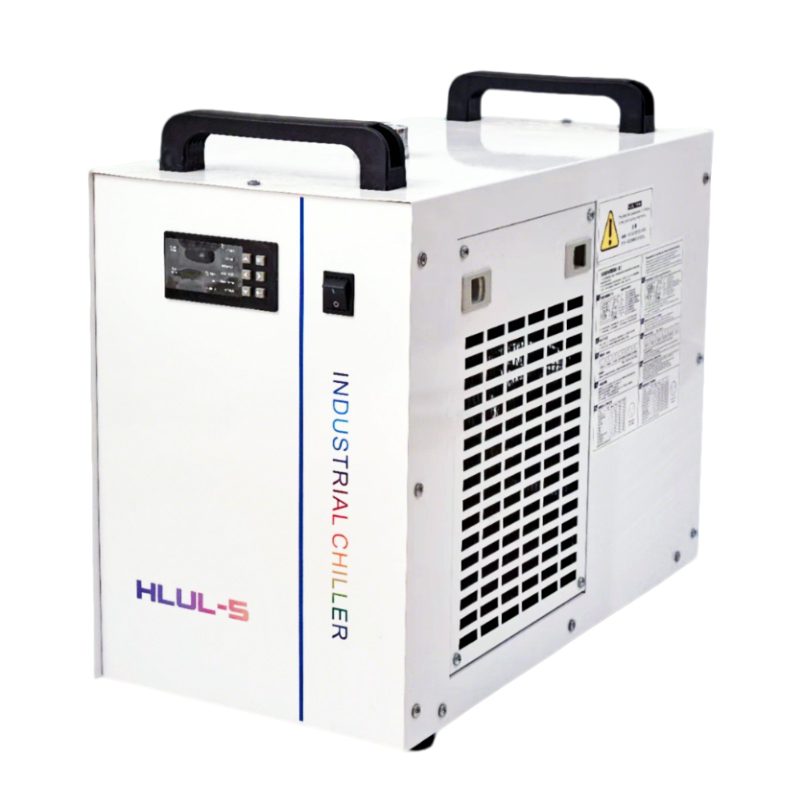
HLUL-5 High Precision Industrial Water Chiller
0.38KW Power
UV Laser Cooling
For UV laser applications, maintaining ±0.1℃ precision is vital to prevent frequency shifting and ensure beam stability. Always check water quality monthly.
Product Introduction
The HLUL-5 UV laser chiller is a ruggedized cooling solution designed to ensure the smooth and continuous operation of high-end industrial equipment. Featuring a sophisticated digital control panel and a heavy-duty handle for portability, it balances high-performance refrigeration with ease of use. This model is the preferred choice for sectors requiring stringent thermal management, such as precision laser engraving and CNC tool cooling.
Product Parameters (Technical Data)
| Parameter Specification | Details (HLUL-5) |
|---|---|
| Voltage | AC 1P 220V-240V / 110V |
| Nominal Cooling Capacity | 0.38KW (1296Btu/h) |
| Temperature Stability (Precision) | ±0.1℃ |
| Pump Max. Flow | 16L/min |
| Refrigerant | R134a |
| Tank Capacity | 6L |
| Safety Protection | Flow, high/low temp, compressor overload alarms |
Product Features & Details
Ultra-Precise Temperature Control
The HLUL-5 utilizes advanced capillary throttling and intelligent sensors to maintain a stability of ±0.1℃. This level of precision is essential for delicate UV laser applications where even a minor temperature swing can impact beam quality.
Industrial-Grade Durability
Designed for 24/7 industrial use, the HLUL-5 features compressor overload protection and a high-flow pump system. Built according to ISO Standards, it ensures long-term reliability in harsh workshop environments.
Product Working Principle
The chiller operates on a vapor-compression cycle: refrigerant absorbs heat from the circulating water via the evaporator, is compressed, and then releases that heat through the condenser. This continuous cycle ensures the water sent to your laser remains at the exact set temperature.
Ventilation Distance Requirements
To ensure optimal cooling efficiency and longevity of the compressor, please maintain a minimum distance of 50cm from the air outlet (back) to obstacles, and 30cm for the air inlets (sides).
